
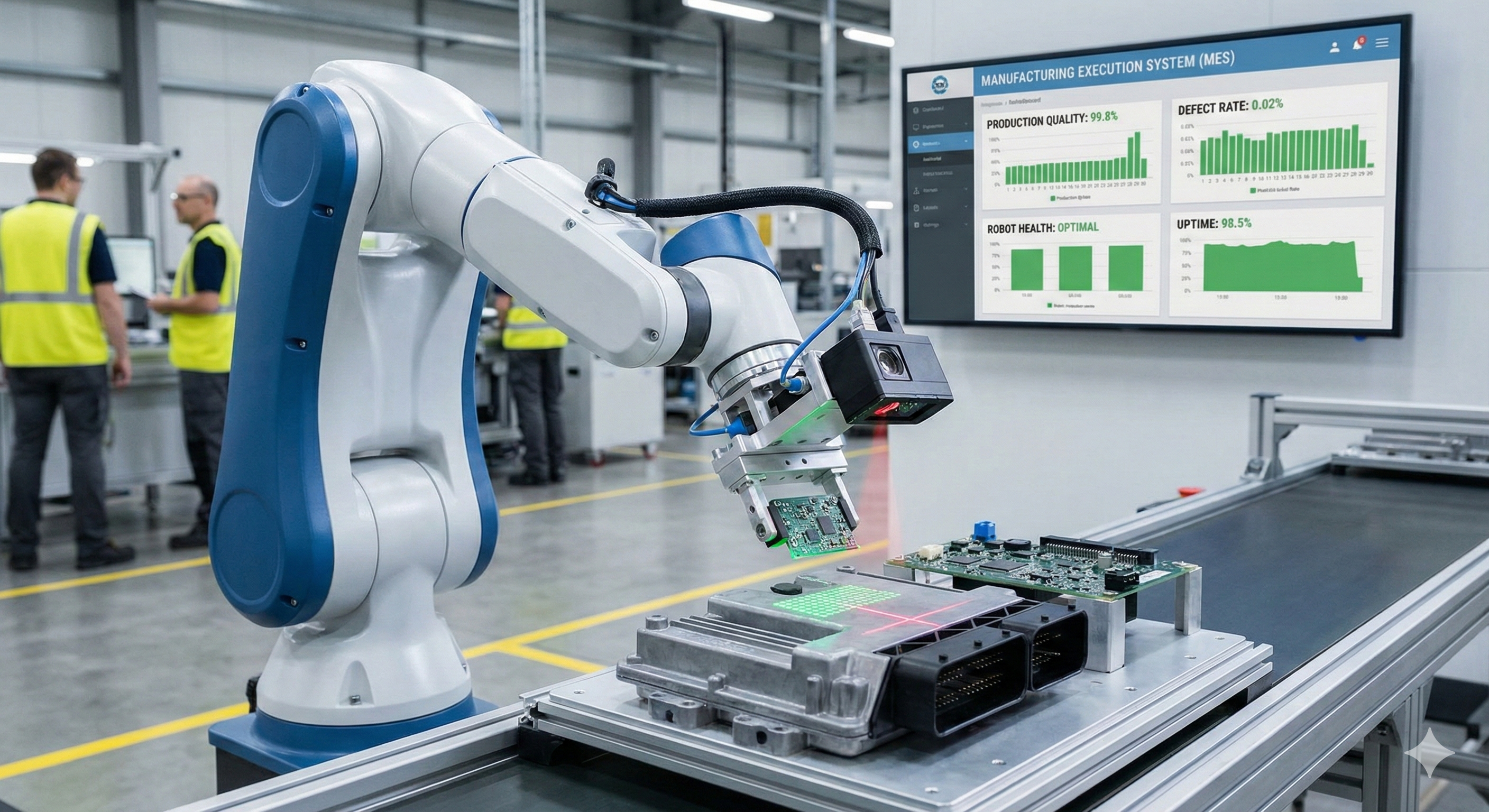
The team faced defect escape, limited inspection capacity, and tension between throughput and quality. Manual checks were variable and difficult to scale across shifts.
Key challenges included:
- Rigid robotic programs unable to adapt to variation
- Manual inspection lagging behind robotic cycle times
- Defects caused by subtle motion drift and tool wear
- High effort required to reprogram robots for new tasks
- Need to integrate with MES and quality systems
Our approach includes robotic arm Physical AI combining perception, motion planning, and self-learning with predictive maintenance and digital twins. Robots learn task-specific skills through demonstration and continuous self-learning, rather than static programming. A full-stack platform unifies robotic control, perception, and quality intelligence.
The solution enabled:
- Real-time perception-driven inspection
- Adaptive robotic motion planning
- Self-learning from demonstrations and production feedback
- Predictive maintenance for robotic joints and tools
- Digital twin–based defect reasoning
- Integration with MES and quality systems
Systems designed for demanding robotic assembly environments with a focus on documented reliability.
- 1Perception models observe parts, tools, and robotic motion in real time
- 2Motion planning adapts trajectories based on variability
- 3Digital twins explain defects using motion and health data
- 4Agentic workflows guide corrective actions
- Reduction in assembly defects
- Faster adaptation to new product variants
- 16-hour continuous autonomous operation
- Reduced manual robot reprogramming
- Higher robotic autonomy
- Faster deployment and iteration
- Explainable, traceable quality
- Scalable production without complexity
Get started with industrial AI
Deploy agentic systems and computer vision with proven ROI and safety-first reliability.